Gossiping About Private Lives Is Holding Our Nation Back

Abu Sufian
Diplomatic Editor
Obsessing over other people's private lives is holding us back as a nation.
In no serious country is it "news" that someone spent a night with a woman who is not his wife, where he drank, which casino he visited, or whom he spoke to on a video call. Those details become serious only when the woman involved alleges that what happened was socially or religiously illicit or was kept secret against her will. Another path to accountability is when a wife herself complains about her husband's multiple relationships or drinking. Then the conduct is punishable and rightly open to censure.
When a man and a woman choose to live together through marriage or a clear promise, and one partner breaks that promise, the right to punish belongs first to the companion. She may sue and leave him behind bars for years, or she may forgive. That choice is hers alone.
In Bangladesh, a private video, a phone call with another woman, or photos of drinking can destroy a person's political career, social standing, and private life overnight. For the media, the private failings of well-known people are treated as major stories. Poking into others' private lives has become a national pastime.
Drinking and extramarital relationships are not endorsed by state law, religious values, or social norms; they are treated as punishable. That standard is healthy and should remain. But such matters do not deserve national headlines until a family member or someone harmed takes them to the police or the press. If a husband deceives his wife, she has every right to make his life a living hell. That is what marriage means. It is not my business, your business, the media's business, or the state's business to turn it into a circus.
When we read these stories, take sides, and argue for or against them, we gain nothing but wasted hours.
A small example. I follow diplomacy closely. For me, yesterday's most important news was the Foreign Ministry's statement that Sheikh Hasina would not be given a travel pass. For my friend Maruf, a sports reporter, the biggest story was India's win in the opening match of the SAFF football championship. Neither of those items dominated tea stalls or friend-circle chats. Yet almost everyone spent at least two or three minutes on one question: who pushed Pori Moni, or whom did Pori Moni push?
Tell me honestly: what national, personal, or social gain did we earn from a countrywide fixation on that incident? Or was it simply a brutal waste of private time?
The second "biggest" story quickly became a phone conversation involving Amir Hamza, a Jamaat MP who claims Awami League roots by inheritance. This Facebook post is not about any particular celebrity's fan base — though that culture is relevant too. And by midnight, the main talking point had become former MP Golam Mawla Rony's alleged second marriage. How many times has he married, or how many women have accused him? What do you or I gain by broadcasting that, debating it, and burning our evenings on it?
Every few days in Bangladesh another video, audio clip, or photo is made to go viral, and day after day we pour precious time into it. As a nation we fall behind. This is not how mature societies spend their public attention.
Jamaat's shadow minister for women's affairs, Gazi Nazrul, has certainly done wrong — but not only in the way the gossip frames it. For marrying again while keeping a first wife, or for illicit intimacy, he answers to Almighty Allah and to his lawful first wife, not to the street. What we should condemn without hesitation is something else: destroying the life of a 17-year-old minor with the lure of a job. And if there was inducement to suicide, he must face the law.
There is no meaningful gain for me, for you, for society, or for the state in chewing over people's private lives. The world is living through hard times. Even advanced countries struggle despite working together. We will not succeed by spending hours on Facebook digging into strangers' bedrooms.
As long as private scandal remains our public obsession — and the administration treats it as high stakes — a dangerous vulnerability remains. Imagine a video of a ruling-party or opposition MP in foreign hands. With that clip, outsiders can pressure that lawmaker into almost anything. Or suppose a secretary or military officer has a drinking tape or an intimate video with another woman. Threatened with release, what could they not be forced to do? Do we grasp how serious that is?
If society treated such material mainly as grounds for moral censure, blackmail would lose much of its power. But when we turn every private failing into career destruction, we — not only the individuals — pay the price.
Huge numbers of Bangladeshis travel abroad. They see Europe's civility and America's systems of progress and global leadership. Yet their habits of mind do not change. They still laugh at other people's leaked videos and call it entertainment.
The days of wasting this nation's valuable time on religious businessman Amir Hamza, or on the tenants of room 501, must end. Unchecked artificial intelligence already threatens humanity. The independence and sovereignty of every country are under strain; no state can claim to be fully self-sufficient. In that world sits promising Bangladesh — a land where growing food is easier than almost anywhere, with vast reserves of sweet water, and a chance to suffer relatively less in the coming global crisis. But if, as a people, we remain stuck on others' most private wrongs, politics, society, and the state will never find stability.
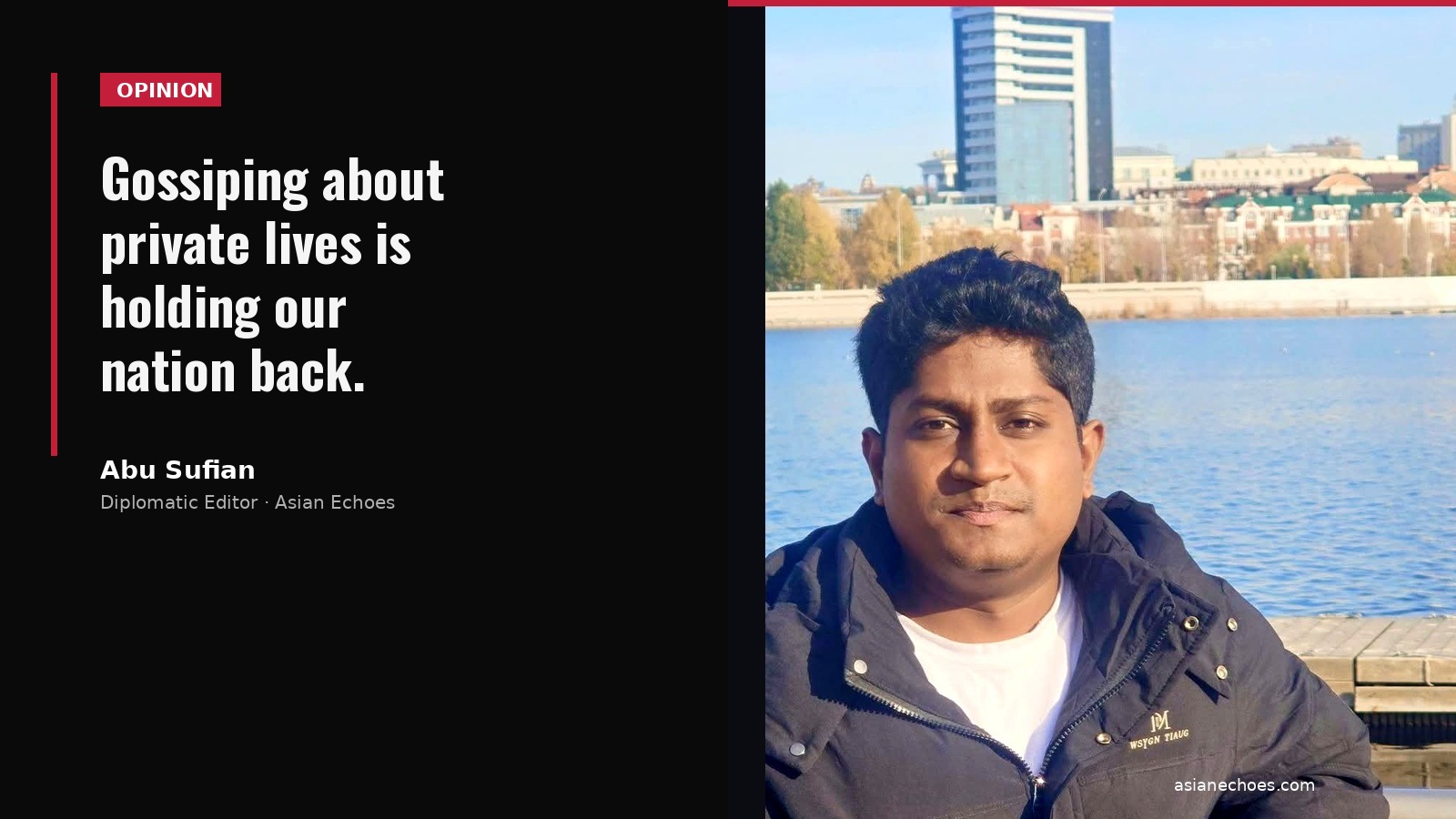
Photo: Abu Sufian